The Claw Putting Grip Is Growing — And There’s a Reason
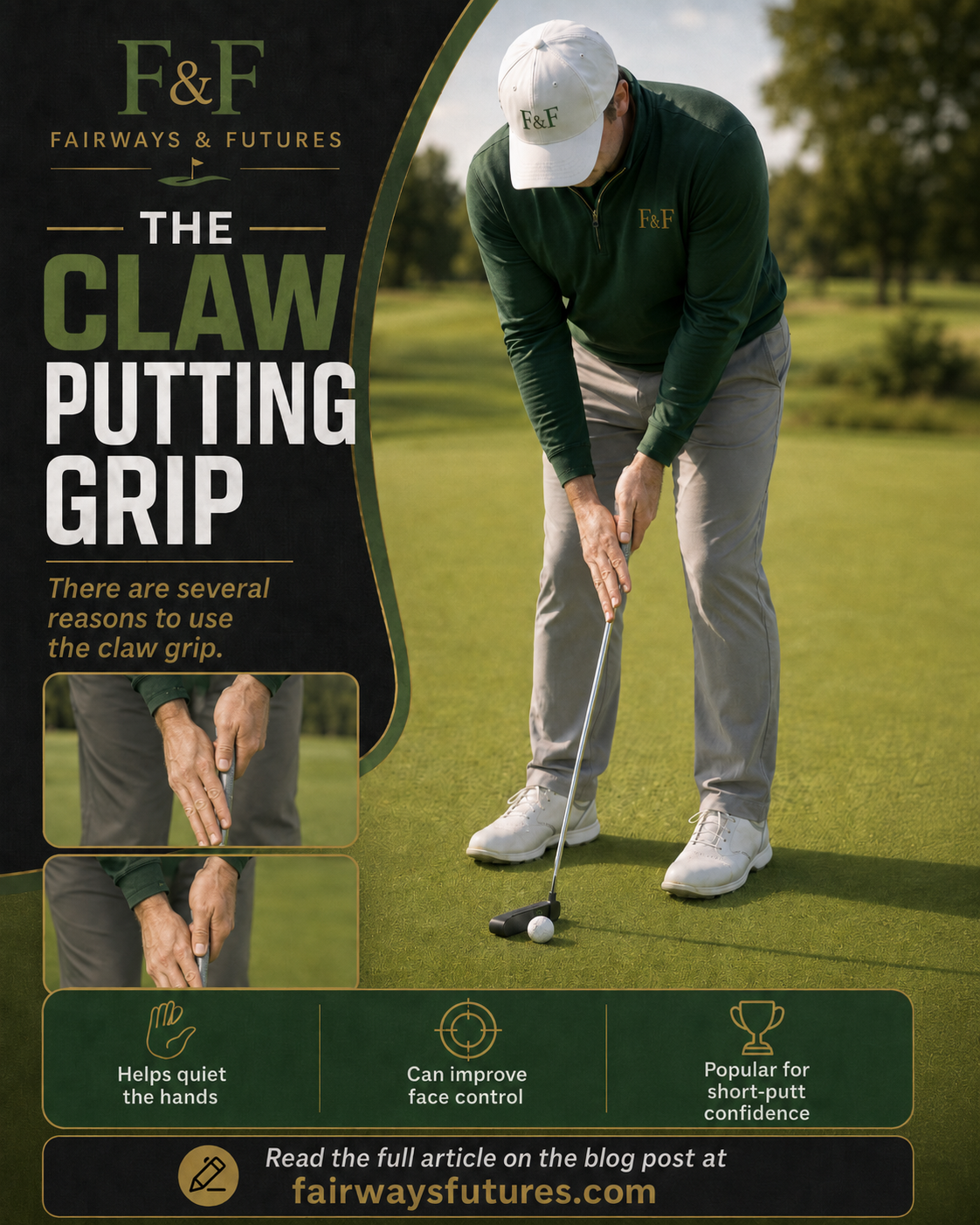
Image created with AI
The claw putting grip is becoming more common in golf, especially among players who want more confidence on short putts.
A lot of golfers still use a traditional putting grip, and there is nothing wrong with that. But when the hands get too active, especially from six feet and in, putting can get shaky fast. The trail hand can push, flip, twist, or jab at the ball. That small hand movement can send the putter face offline and cause missed short putts.
That is where the claw can help.
The claw grip puts the trail hand in a more passive position. Instead of wrapping fully around the grip and controlling the stroke, the trail hand sits more on the side of the putter. This can help quiet the hands and let the shoulders, arms, and lead hand control the stroke more naturally.
For golfers who struggle with short-putt nerves or the yips, that can be a big deal.
One major benefit of the claw is that it can help you make a longer, smoother stroke on short putts. Many golfers get too tense inside six feet. They make the stroke short, quick, and jabby. The claw can reduce that hit impulse and help the putter move back and through with better rhythm.
A smoother stroke usually means better face control.
Putting is all about starting the ball on line. Even a small twist of the face can cause a miss. By reducing the trail hand’s influence, the claw can make it easier to keep the putter face stable through impact.
The claw is not magic, and it is not for everyone. Some players will prefer a traditional grip. But if you struggle with overactive hands, short-putt anxiety, face control, or the yips, it is worth testing.
The grip may look different, but the scorecard does not care how your hands look. It only cares whether the ball goes in.
The claw grip is growing because it gives many golfers a simple way to quiet the hands, smooth out the stroke, and build more confidence on the greens.
If short putts have been costing you strokes, the claw might be worth a serious look.
Timid Traders Never Win Much: Be Bold When the Setup Is There
Trading does not reward fear. It rewards preparation, patience, discipline, and execution.
There is a difference between being careful and being timid. A careful trader respects risk. A timid trader sees the right setup, knows the plan, hesitates anyway, and watches the move leave without them. You can do all the work — study the chart, mark the levels, wait for structure, recognize the setup — but when the moment comes, you still have to execute. That is where timid traders struggle. They enter too small because they fear losing, cut winners early because they fear giving money back, then chase late because they fear missing out. None of that is discipline. That is fear wearing a discipline costume.
Bold Does Not Mean Reckless
Bold trading is not swinging wildly, forcing trades, or pressing buttons for action. It means this: you waited for your setup, you identified the structure, you know where you are wrong, you know the risk, you know the target — and when the moment comes, you take the trade. That is the difference between gambling and trading. A gambler goes big for the thrill. A trader goes bigger only when the setup deserves it.
Selectivity is a strength. But once the market gives you the clean structure you were waiting for, you cannot trade like you are still unsure. The whole point of waiting is to act with conviction when the opportunity finally appears.
The Market Does Not Pay You for Being Scared
The market does not care how nervous you are or how many times you almost entered. The only thing that matters is whether you executed the plan. A lot of traders are good analysts but poor executors — they can explain the setup perfectly after it happens but struggle to participate when it is live. That creates a painful cycle: you wait, you see the setup, you hesitate, the trade works without you, you get frustrated, and you chase the next weaker setup. That is how timid trading turns into bad trading.
The solution is not to take every trade. It is to define your best setups clearly enough that when one appears, you already know what to do.
Trust Your Work, Size With Confidence
Confidence comes from preparation, not guessing. Before you enter, you should already know the structure, the entry, the invalidation point, the stop, the target, and whether the reward is worth the risk. If it is your setup, you cannot keep trading scared of your own plan.
Going big does not mean being stupid with size — it means sizing appropriately when trade quality is high. A low-quality setup gets skipped or taken small. A clean setup deserves real commitment. But conviction must live inside risk management. A bold trader does not say, "I can't lose." A bold trader says, "This is my setup. I know where I'm wrong. I accept the risk."
Let Your Winners Have Room
Timid traders finally enter a good trade, then exit too early out of fear. They wait forever to get in, then panic at the first sign of green. That is not how big trades are built. If the setup is strong, risk is controlled, and price is moving your way, give the trade room to work. The best trades often require sitting through discomfort — pullbacks, hesitation, candles that don't go straight to target. That is why the plan matters: you need structure to lean on when emotion starts talking.
Controlled Aggression
The best traders are neither timid nor reckless. They are controlled. Patient while waiting. Aggressive when executing. Calm when managing. Disciplined when exiting.
In golf, you do not swing scared when the shot fits your eye. You pick the target, commit, and trust the swing. A scared swing makes a bad shot; a scared trade makes a bad entry, bad management, or no trade at all.
Final Thought
Discipline is not being afraid to trade. Discipline is waiting for the right trade and executing it with confidence. When the market is messy, be patient. When the setup is weak, stay out. But when the structure is clean and the risk is defined, do not trade scared.
Be bold when the time is right. Plan. Execute. Win.
Full description of a pre-shot routine
Step 1: Assess the lie and wind conditions. Are you on an uphill, downhill or sidehill lie? Make sure you make adjustments for the shot even if it’s slightly uphill, downhill or sidehill. What direction is the wind and how strong is it? Are you in the rough or fairway? If you are in a bad lie how bad is it what can you do with it? If the lie is extreme at all you will want to use more club and do a three quarter or 90 degree shot, the reason for this is because your body will likely naturally not do a full swing if you start to lose your balance. So for shots where you will slightly lose your balance you will have to commit to a three quarter or 90 degree type swing.
Step 2: Commit to the type of shot you would like to hit and the target, pick a very precise target. Are you hitting a fade, draw, low or high shot? You can do aim and shoot also if that’s working well, it’s not a must to intentionally work the ball. Play your best shot type if you have the ability to do so given the conditions. Example you can’t hit a draw if the shot calls for a low punch fade. Remember the precise target will change based on distance. For me if I’m 185 yards out I’m trying to stay safe and make par so I aim at the center of the “par zone” area and away from danger. If I’m 75 to 130 yards out I’m likely aiming extremely close to the pin even if danger is close by.
Step 3: Obtain the yardage and choose a club. If you use a yardage book as I teach and you 165 yards out. For one club a full swing travels 165 and a three quarter swing that goes 163 for another club use the three quarter swing for increased accuracy.
Step 4: Go through a full shot routine with confidence and self belief. The final part is the practice swing and and shoot, but it needs to be extremely detailed once you grab that club. Here is an example: Pull the club out of the bag, two practice swings for the shot you are committing to from behind the ball. Pick the line and approach the ball. Set up stance, check weight and ball position, make any adjustments, look at the target, look at the ball waggle twice, look at the target again, look back to the ball, make one more waggle and swing. Most amateur’s are not as nearly detailed as the pros when it comes to this part.
5 Successful Golf Swing Styles (Copy)
It All Begins Here
There is not one perfect golf swing. Great players win with different patterns, tempos, takeaways, and body types. The key is finding the swing style that matches your natural motion and holds up under pressure. There are 4 examples over the years of winners with short swings that go barely beyond the half way 90 degree angle. I’ve studied golf for almost 40 years and I’ve identified 5 common successful swing types on tour. What’s really important is solid contact and consistency. In my e-book I will thoroughly go through each of the 5 proven swings what body type works best for each body type as well as common cues and pitfalls for each, as well as much much more…
Why Discipline Beats More Trades
Trading success is not about taking every setup. It is about waiting for clean structure, managing risk, and protecting your account when the market is not giving you your edge. Fairways & Futures is about trading with patience, discipline, and a plan — not chasing every candle. If you have not sat patiently watching the charts for over an hour without making a trade, or identified from the structure that it’s not a good time to trade and walked away you likely don’t have the proper discipline built yet.